1. What is \( \mathop{\lim }\limits_{{x \rightarrow \frac{\pi }{4}}}\tan x \) ?
第47题
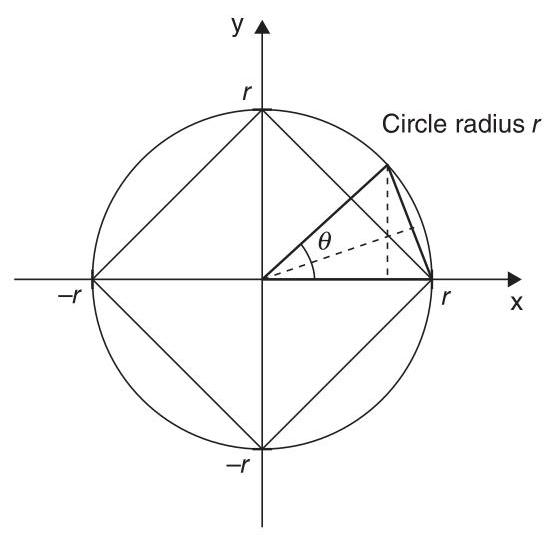
47. (A) Use a limit to verify the formula for the area of a circle using inscribed n-gons.
1. What is \( \mathop{\lim }\limits_{{x \rightarrow \frac{\pi }{4}}}\tan x \) ?
答案: ( C )
\( \mathop{\lim }\limits_{{x \rightarrow \pi /4}}\tan x = \tan \frac{\pi }{4} = 1 \) by direct substitution.
2. Find the limit: \( \mathop{\lim }\limits_{{t \rightarrow - 3}}\frac{t + 3}{{t}^{2} + 9} \) .
答案: ( B )
\( \mathop{\lim }\limits_{{t \rightarrow - 3}}\frac{t + 3}{{t}^{2} + 9} = \frac{\left( {-3}\right) + 3}{{\left( -3\right) }^{2} + 9} = \frac{0}{18} = 0 \) by direct substitution.
3. Find the limit: \( \mathop{\lim }\limits_{{x \rightarrow 3}}\frac{{x}^{3} + 2{x}^{2} - {9x} - {18}}{x - 3} \) .
答案: ( B )
Factoring the numerator gives you \[ \mathop{\lim }\limits_{{x \rightarrow 3}}\frac{\left( {x - 3}\right) \left( {x + 3}\right) \left( {x + 2}\right) }{x - 3} = \mathop{\lim }\limits_{{x \rightarrow 3}}\left( {x + 3}\right) \left( {x + 2}\right) = 6 \cdot 5 = {30}. \]
4. Find the limit: \( \mathop{\lim }\limits_{{t \rightarrow 0}}\frac{\sqrt{4 - t} - 2}{t} \) .
答案: ( C )
Multiply the expression by a convenient form of 1 and obtain \[ \mathop{\lim }\limits_{{t \rightarrow 0}}\left( \frac{\sqrt{4 - t} - 2}{t}\right) \left( \frac{\sqrt{4 - t} + 2}{\sqrt{4 - t} + 2}\right) = \mathop{\lim }\limits_{{t \rightarrow 0}}\frac{-t}{t\left( {\sqrt{4 - t} + 2}\right) } = \mathop{\lim }\limits_{{t \rightarrow 0}}\frac{-1}{\left( \sqrt{4 - t} + 2\right) } = \frac{-1}{\sqrt{4} + 2} = \frac{-1}{4}. \]
5. Find the limit: \( \mathop{\lim }\limits_{{s \rightarrow 9}}\frac{9 - s}{\sqrt{s} - 3} \) .
答案: ( C )
Multiplying top and bottom by the conjugate of the denominator yields \[ \mathop{\lim }\limits_{{s \rightarrow 9}}\left( \frac{9 - s}{\sqrt{s} - 3}\right) \left( \frac{\sqrt{s} + 3}{\sqrt{s} + 3}\right) = \mathop{\lim }\limits_{{s \rightarrow 9}}\frac{\left( {9 - s}\right) \left( {\sqrt{s} + 3}\right) }{\left( s - 9\right) } = \mathop{\lim }\limits_{{s \rightarrow 9}} - \sqrt{s} - 3 = - \sqrt{9} - 3 = - 6. \]
6. Find the limit: \( \mathop{\lim }\limits_{{x \rightarrow \infty }}\frac{x + 4}{{x}^{2} + {16}} \) .
答案: ( C )
The expression \( \frac{x + 4}{{x}^{2} + {16}} \) must be rewritten so that you can apply the Limit Theorem. You do this by multiplying numerator and denominator by \( \frac{1}{{x}^{2}} \) . \[ \mathop{\lim }\limits_{{x \rightarrow \infty }}\frac{\frac{1}{x} + \frac{4}{{x}^{2}}}{1 + \frac{16}{{x}^{2}}} = \frac{\mathop{\lim }\limits_{{x \rightarrow \infty }}\frac{1}{x} + \mathop{\lim }\limits_{{x \rightarrow \infty }}\frac{4}{{x}^{2}}}{\mathop{\lim }\limits_{{x \rightarrow \infty }}1 + \mathop{\lim }\limits_{{x \rightarrow \infty }}\frac{16}{{x}^{2}}} = \frac{0 + 0}{1 + 0} = 0 \]
7. Find the limit: \( \mathop{\lim }\limits_{{\theta \rightarrow - \infty }}\frac{\sin \theta }{\theta } \) .
答案: ( A )
Since \( - 1 \leq \sin \theta \leq 1 \) as \( \theta \) decreases without bound, \( \mathop{\lim }\limits_{{\theta \rightarrow - \infty }}\frac{\sin \theta }{\theta } = 0 \) .
8. Find the limit: \( \mathop{\lim }\limits_{{t \rightarrow \infty }}\frac{\sqrt[3]{{t}^{3} - 8}}{2t} \) .
答案: ( B )
Multiplying the denominator by \( \frac{1}{t} \) and the numerator by \( \frac{1}{\sqrt[3]{{t}^{3}}} = \frac{1}{t} \) yields \( \mathop{\lim }\limits_{{t \rightarrow \infty }}\frac{\sqrt[3]{1 - \frac{8}{{t}^{3}}}}{2} = \frac{\sqrt[3]{1}}{2} = \frac{1}{2}. \)
9. Find the limit: \( \mathop{\lim }\limits_{{x \rightarrow 0}}\frac{4{x}^{2}}{1 - \cos {2x}} \) .
答案: ( B )
Multiply the numerator and denominator by the conjugate of \( 1 - \cos {2x} \) and get \[ \mathop{\lim }\limits_{{x \rightarrow 0}}\left( \frac{4{x}^{2}}{1 - \cos {2x}}\right) \left( \frac{1 + \cos {2x}}{1 + \cos {2x}}\right) = \mathop{\lim }\limits_{{x \rightarrow 0}}\frac{4{x}^{2}\left( {1 + \cos {2x}}\right) }{1 - {\cos }^{2}{2x}} = \mathop{\lim }\limits_{{x \rightarrow 0}}\frac{4{x}^{2}}{{\sin }^{2}{2x}} \cdot \mathop{\lim }\limits_{{x \rightarrow 0}}\left( {1 + \cos {2x}}\right) = {\left( \mathop{\lim }\limits_{{x \rightarrow 0}}\frac{2x}{\sin {2x}}\right) }^{2} \cdot \mathop{\lim }\limits_{{x \rightarrow 0}}\left( {1 + \cos {2x}}\right) = {\left( 1\right) }^{2} \cdot 2 = 2 \]
10. Find the limit: \( \mathop{\lim }\limits_{{\theta \rightarrow 0}}\frac{{\cos }^{2}\theta - 1}{\theta \cos \theta + \theta } \) .
答案: ( B )
Factoring the numerator and denominator allows the following simplification: \[ \mathop{\lim }\limits_{{x \rightarrow 0}}\frac{\left( {\cos \theta - 1}\right) \left( {\cos \theta + 1}\right) }{\theta \left( {\cos \theta + 1}\right) } = \mathop{\lim }\limits_{{x \rightarrow 0}}\frac{\left( \cos \theta - 1\right) }{\theta } \] L'Hôpital's rule: \( \mathop{\lim }\limits_{{x \rightarrow c}}\frac{f\left( x\right) }{g\left( x\right) } = \mathop{\lim }\limits_{{x \rightarrow c}}\frac{{f}^{\prime }\left( x\right) }{{g}^{\prime }\left( x\right) } \) , so \( \mathop{\lim }\limits_{{x \rightarrow 0}}\frac{\left( \cos \theta - 1\right) }{\theta } = \mathop{\lim }\limits_{{x \rightarrow 0}}\left( {-\sin \theta }\right) = 0 \)
11. Find the limit: \( \mathop{\lim }\limits_{{y \rightarrow 0}}\frac{\left( {\tan y}\right) \left( {\cos y}\right) }{y} \) .
答案: ( C )
Common trigonometric identities: \( \mathop{\lim }\limits_{{y \rightarrow 0}}\frac{\left( \tan y\right) \cos y}{y} = \mathop{\lim }\limits_{{y \rightarrow 0}}\frac{\sin y}{y} \) . Applying L'Hôpital's rule: \( \mathop{\lim }\limits_{{y \rightarrow 0}}\frac{\sin y}{y} = \mathop{\lim }\limits_{{y \rightarrow 0}}\cos y = 1 \) .
12. Find the limit: \( \mathop{\lim }\limits_{{z \rightarrow - 1}}\frac{{z}^{3} + 1}{z + 1} \) .
答案: ( C )
Factoring the numerator: \[ \mathop{\lim }\limits_{{z \rightarrow - 1}}\frac{{z}^{3} + 1}{z + 1} = \mathop{\lim }\limits_{{z \rightarrow - 1}}\frac{\left( {z + 1}\right) \left( {{z}^{2} - z + 1}\right) }{z + 1} = \mathop{\lim }\limits_{{z \rightarrow - 1}}{z}^{2} - z + 1 = 3 \]
13. Find the horizontal asymptote(s) of \( f\left( t\right) = \frac{{27t} - {18}}{{3t} + 8} \) .
答案: ( A )
Find the limits as \( t \rightarrow \infty \) and \( t \rightarrow - \infty \) : \[ \mathop{\lim }\limits_{{t \rightarrow \infty }}\frac{{27t} - {18}}{{3t} + 8} = \frac{27}{3} = 9 \] and likewise \( t \rightarrow -\infty \) gives 9. So \( y = 9 \) .
14. Find the vertical asymptote(s) of \( f\left( x\right) = \frac{{x}^{2} + {2x} + 1}{{x}^{2} - 1} \) .
答案: ( A )
The expression is undefined for \( x = \pm 1 \). \( \mathop{\lim }\limits_{{x \rightarrow {1}^{ + }}}\frac{x + 1}{x - 1} = \infty \) and \( \mathop{\lim }\limits_{{x \rightarrow {1}^{ - }}}\frac{x + 1}{x - 1} = - \infty \) , so \( x = 1 \) is a vertical asymptote. At \( x = -1 \) the limit is 0, so \( x = -1 \) is not an asymptote.
15. For what value of \( h \) is \( f\left( x\right) = \left\{ \begin{matrix} \frac{6{x}^{2} - {11x} - {10}}{{2x} - 5}, x \neq \frac{5}{2} \\ h, x = \frac{5}{2} \end{matrix}\right. \) continuous at \( x = \frac{5}{2} \) ?
答案: ( D )
\( \mathop{\lim }\limits_{{x \rightarrow 5/2}}\frac{6{x}^{2} - {11x} - {10}}{{2x} - 5} = \mathop{\lim }\limits_{{x \rightarrow 5/2}}\frac{\left( {{2x} - 5}\right) \left( {{3x} + 2}\right) }{{2x} - 5} = \frac{19}{2} \) , so defining \( h = \frac{19}{2} \) makes the function continuous.
16. For what value of \( k \) is \( g\left( x\right) = \left\{ \begin{matrix} {2x} + 7, x \leq 4 \\ - {3x} - k, x > 4 \end{matrix}\right. \) a continuous function?
答案: ( D )
\( g\left( 4\right) = 15 \). For continuity at 4 we need \( -3(4) - k = 15 \), so \( k = -27 \) .
17. Find the value of \( m \) for which \( h\left( x\right) = \left\{ \begin{matrix} {5x} - {13}, x \leq 2 \\ {x}^{2} - {7x} + m, x > 2 \end{matrix}\right. \) is continuous.
答案: ( C )
\( h\left( 2\right) = - 3 \). We need \( {2}^{2} - 7(2) + m = -3 \), so \( m = 7 \) .
18. Which of the following are point(s) of discontinuity of \( f\left( x\right) = \frac{{3x} + 1}{2{x}^{3} - 8{x}^{2} - {64x}} \) ? I. 0 II. 4 III. 8
答案: ( D )
Rational functions are discontinuous where the denominator is 0. \( 2{x}^{3} - 8{x}^{2} - {64x} = 2x\left( {x - 8}\right) \left( {x + 4}\right) = 0 \) gives \( x = 0, 8, -4 \) . So I and III (0 and 8) are correct.
19. On which interval(s) is \( g\left( x\right) = \left\{ \begin{matrix} \frac{{x}^{2} + {4x} - {21}}{{x}^{2} - {8x} + {15}}, x \neq 3,5 \\ - 5, x = 3 \\ - \frac{7}{5}, x = 5 \end{matrix}\right. \) continuous? I. \( \left( {-\infty ,3}\right) \) II. \( \left( {3,\infty }\right) \) III. \( \left( {5,\infty }\right) \)
答案: ( D )
\( g \) is continuous at \( x = 3 \) (limit equals -5). At \( x = 5 \) the limit is \( \infty \), so discontinuous there. Only intervals I and III do not contain \( x = 5 \) .
| ✘ | -2 | 0 | 3 |
| h(x) | 7 | \( a \) | 5 |
20. Let \( h\left( x\right) \) be continuous on \( \left\lbrack {-2,3}\right\rbrack \) with some values shown in the table. If \( h\left( x\right) = 4 \) has no solutions on \( \left\lbrack {-2,3}\right\rbrack \), which of the following are possible for \( a \) ? I. -1 II. 4 III. 6
答案: ( C )
By the Intermediate Value Theorem, since \( h \) never equals 4, \( a = 4 \) is impossible. \( a = -1 \) would be outside the range between 7 and 5. Only \( a = 6 \) (between 7 and 5) is a possible value for which \( h(x) = 4 \) might have no solution.
21. For \( f\left( x\right) = \frac{{x}^{3} - 6{x}^{2} + {11x} - 6}{{x}^{3} - {7x} + 6} \), which point of discontinuity is not removable?
答案: ( A )
At \( x = 1 \) and \( x = 2 \) the discontinuity is removable. At \( x = -3 \) the limit gives a vertical asymptote, so the discontinuity at \( x = -3 \) is not removable.
22. On \( \left\lbrack {a, b}\right\rbrack \), \( \frac{f\left( b\right) - f\left( a\right) }{b - a} \) gives: I. the average rate of change from \( x = a \) to \( x = b \); II. the instantaneous rate of change; III. the slope of the secant line; IV. the slope of the tangent line.
答案: ( C )
\( \frac{f\left( b\right) - f\left( a\right) }{b - a} \) is the slope of the secant line and the average rate of change from \( x = a \) to \( x = b \) .
23. Which represents the removable discontinuity of \( f\left( t\right) = \frac{{t}^{4} - 2{t}^{3} - {13}{t}^{2} + {14t} + {24}}{{t}^{4} - 2{t}^{3} - {13}{t}^{2} + {38t} - {24}} \) ?
答案: ( B )
For a removable discontinuity at \( t = a \), both numerator and denominator must have factor \( (t - a) \). Only \( (t - 2) \) divides both; the removable discontinuity is \( t = 2 \) .
24. Find the vertical asymptote of \( f\left( x\right) = \frac{{x}^{2} + x - {12}}{{x}^{2} - {7x} + {12}} \) .
答案: ( D )
Factor: \( \frac{\left( {x - 3}\right) \left( {x + 4}\right) }{\left( {x - 3}\right) \left( {x - 4}\right) } \) . \( x = 3 \) is removable. At \( x = 4 \) the one-sided limits are \( \pm \infty \), so the vertical asymptote is \( x = 4 \) .
25. For what value of \( k \) is \( f\left( x\right) = \left\{ \begin{matrix} \frac{6{x}^{2} + {5x} - {56}}{{2x} + 7}, x \neq - \frac{7}{2} \\ k, x = - \frac{7}{2} \end{matrix}\right. \) continuous?
答案: ( A )
\( \mathop{\lim }\limits_{{x \rightarrow - 7/2}}\frac{6{x}^{2} + {5x} - {56}}{{2x} + 7} = \mathop{\lim }\limits_{{x \rightarrow - 7/2}}\frac{\left( {{2x} + 7}\right) \left( {{3x} - 8}\right) }{{2x} + 7} = 3(-7/2) - 8 = -\frac{37}{2} \) .
26. For what value of \( h \) is \( g\left( t\right) = \left\{ \begin{matrix} 2{t}^{2} - {8t} + 7, t \geq 5 \\ 2{t}^{3} - 9{t}^{2} - {2t} + h, t < 5 \end{matrix}\right. \) continuous?
答案: ( D )
\( g\left( 5\right) = 2(25) - 40 + 7 = 17 \). We need \( 2(125) - 9(25) - 2(5) + h = 17 \), so \( h = 2 \) .
27. For \( y = f\left( x\right) \), when \( \mathop{\lim }\limits_{{x \rightarrow {3}^{ + }}}f\left( x\right) = \pm \infty \) or \( \mathop{\lim }\limits_{{x \rightarrow {3}^{ - }}}f\left( x\right) = \pm \infty \), \( x = 3 \): I. is a nonremovable point of discontinuity; II. is a removable discontinuity; III. is a horizontal asymptote; IV. is a vertical asymptote.
答案: ( D )
When the function tends to \( \pm \infty \) near \( x = 3 \), \( x = 3 \) is a vertical asymptote and a nonremovable discontinuity.
28. On which interval(s) is \( g\left( t\right) = \left\{ \begin{matrix} \frac{4{t}^{2} - {8t} - {21}}{4{t}^{2} - {20t} + {21}}, t \neq \frac{3}{2},\frac{7}{2} \\ - 1, t = \frac{3}{2} \\ 0, t = \frac{7}{2} \end{matrix}\right. \) continuous? I. \( \left( {-\infty ,\frac{3}{2}}\right) \) II. \( \left( {-\infty ,\frac{7}{2}}\right) \) III. \( \left( {\frac{3}{2},\infty }\right) \)
答案: ( A )
The function simplifies; \( t = \frac{3}{2} \) is a removable discontinuity (limit \( -\frac{5}{2} \) but defined as -1). There is a vertical asymptote at \( t = \frac{7}{2} \). Only \( \left( {-\infty ,\frac{3}{2}}\right) \) contains neither.
29. Find the horizontal asymptote(s) of \( f\left( x\right) = \frac{x}{{x}^{2} + 1} \) . I. \( y = - 1 \) II. \( y = 0 \) III. \( y = 1 \)
答案: ( B )
\[ \mathop{\lim }\limits_{{x \rightarrow \infty }}\frac{x}{{x}^{2} + 1} = \mathop{\lim }\limits_{{x \rightarrow \infty }}\frac{1/x}{1 + 1/{x}^{2}} = 0 \] and similarly as \( x \rightarrow -\infty \). So \( y = 0 \) is the horizontal asymptote.
30. Which represents the removable discontinuity of \( f\left( x\right) = \frac{{x}^{4} - 7{x}^{3} + 5{x}^{2} + {31x} - {30}}{{x}^{4} + {x}^{3} - {19}{x}^{2} + {11x} + {30}} \) ?
答案: ( C )
Factoring numerator and denominator, the common factor \( (x - 3) \) cancels; the only removable discontinuity is at \( x = 3 \) .
31. For what value of \( a \) is the function \( g\left( x\right) = \left\{ \begin{matrix} \frac{{x}^{4} - {x}^{3} + x - 1}{x - 1}, x \neq 1 \\ a, x = 1 \end{matrix}\right. \) continuous?
答案: ( C )
\( \mathop{\lim }\limits_{{x \rightarrow 1}}\frac{{x}^{4} - {x}^{3} + x - 1}{x - 1} = \mathop{\lim }\limits_{{x \rightarrow 1}}\frac{\left( {{x}^{3} + 1}\right) \left( {x - 1}\right) }{x - 1} = \mathop{\lim }\limits_{{x \rightarrow 1}}{x}^{3} + 1 = 2 \) . So \( a = 2 \) .
32. For the function \( f\left( x\right) = \frac{2{x}^{3} + {x}^{2} - {25x} + {12}}{2{x}^{3} + 3{x}^{2} - {23x} - {12}} \), which point of discontinuity is not removable?
答案: ( C )
Factoring: \( \frac{\left( {{2x} - 1}\right) \left( {x + 4}\right) \left( {x - 3}\right) }{\left( {{2x} + 1}\right) \left( {x + 4}\right) \left( {x - 3}\right) } = \frac{2x - 1}{2x + 1} \). So the discontinuity that is not removable is at \( x = - \frac{1}{2} \) (denominator zero, not cancelled).
33. Find the value of \( b \) so that \( f\left( x\right) = \left\{ \begin{matrix} \frac{\sqrt{{x}^{2} + 1} - 1}{x}, x \neq 0 \\ b, x = 0 \end{matrix}\right. \) is continuous.
答案: ( C )
Multiply by conjugate: \( \mathop{\lim }\limits_{{x \rightarrow 0}}\frac{\sqrt{{x}^{2} + 1} - 1}{x} = \mathop{\lim }\limits_{{x \rightarrow 0}}\frac{{x}^{2}}{x\left( \sqrt{{x}^{2} + 1} + 1\right) } = \mathop{\lim }\limits_{{x \rightarrow 0}}\frac{x}{\sqrt{{x}^{2} + 1} + 1} = 0 \). So \( b = 0 \) .
34. Find the value of \( c \) so that \( h\left( t\right) = \left\{ \begin{matrix} \frac{{t}^{2} - 4}{{t}^{3} - 8}, t \neq 2 \\ c, t = 2 \end{matrix}\right. \) is continuous.
答案: ( B )
\( \mathop{\lim }\limits_{{t \rightarrow 2}}\frac{{t}^{2} - 4}{{t}^{3} - 8} = \mathop{\lim }\limits_{{t \rightarrow 2}}\frac{\left( {t - 2}\right) \left( {t + 2}\right) }{\left( {t - 2}\right) \left( {{t}^{2} + {2t} + 4}\right) } = \frac{4}{12} = \frac{1}{3} \) . So \( c = \frac{1}{3} \) .
35. Find the value of \( k \) so that \( g\left( x\right) = \left\{ \begin{matrix} \frac{{x}^{2} + 1}{x + 1}, x \neq - 1 \\ k, x = - 1 \end{matrix}\right. \) is continuous.
答案: ( D )
At \( x = -1 \) the denominator is 0; the left-hand and right-hand limits differ (e.g. \( -\infty \) vs \( +\infty \)), so the limit does not exist. The discontinuity at \( x = -1 \) is not removable.
| ✘ | -5 | -4 | -2 |
| h(x) | -11 | \( a \) | -3 |
36. Let \( h\left( x\right) \) be continuous on \( \left\lbrack {-5, - 2}\right\rbrack \) with some values shown in the table. If \( h\left( x\right) = - 1 \) has no solutions on \( \left\lbrack {-5, - 2}\right\rbrack \), which of the following are possible for \( a \) ? I. -4 II. -3 III. 0
答案: ( D )
By the Intermediate Value Theorem, since \( h \) never attains -1 on \( [-5,-2] \), it cannot attain any value greater than -1 there either. So only \( a = -4 \) and \( a = -3 \) (both \( \leq -1 \)) are possible; \( a = 0 \) is not.
37. On which interval(s) is \( g\left( x\right) = \left\{ \begin{matrix} \frac{{x}^{2} - {2x} - {24}}{{x}^{2} + {10x} + {24}}, x \neq - 4, - 6 \\ - 5, x = - 4 \\ - 5, x = - 6 \end{matrix}\right. \) continuous? I. \( \left( {-\infty , - 4}\right) \) II. \( \left( {-4,6}\right) \) III. \( \left( {-4,\infty }\right) \)
答案: ( D )
At \( x = -4 \) the limit equals -5 = g(-4), so continuous there. At \( x = -6 \) the left and right limits are \( -\infty \) and \( +\infty \), so discontinuous. Intervals II and III omit \( x = -6 \) .
38. Find the limit: \( \mathop{\lim }\limits_{{x \rightarrow 0}}\frac{\sqrt{6 - x} - \sqrt{6}}{x} \) .
答案: ( B )
Multiply by conjugate: \( \mathop{\lim }\limits_{{x \rightarrow 0}}\frac{\sqrt{6 - x} - \sqrt{6}}{x} \cdot \frac{\sqrt{6 - x} + \sqrt{6}}{\sqrt{6 - x} + \sqrt{6}} = \mathop{\lim }\limits_{{x \rightarrow 0}}\frac{-1}{\sqrt{6 - x} + \sqrt{6}} = -\frac{1}{2\sqrt{6}} = -\frac{\sqrt{6}}{12} \) .
39. Find the limit: \( \mathop{\lim }\limits_{{x \rightarrow {11}}}\frac{\sqrt{x + 5} - 4}{x - {11}} \) .
答案: ( C )
Multiply by conjugate: \( \mathop{\lim }\limits_{{x \rightarrow {11}}}\frac{\sqrt{x + 5} - 4}{x - {11}} \cdot \frac{\sqrt{x + 5} + 4}{\sqrt{x + 5} + 4} = \mathop{\lim }\limits_{{x \rightarrow {11}}}\frac{1}{\sqrt{x + 5} + 4} = \frac{1}{8} \) .
40. Find the limit: \( \mathop{\lim }\limits_{{x \rightarrow 0}}\frac{\sin {x}^{3}}{{x}^{2}} \) .
答案: ( B )
\( \mathop{\lim }\limits_{{x \rightarrow 0}}\frac{\sin {x}^{3}}{{x}^{2}} = \mathop{\lim }\limits_{{x \rightarrow 0}}\frac{x\sin {x}^{3}}{{x}^{3}} = \mathop{\lim }\limits_{{x \rightarrow 0}}x \cdot \mathop{\lim }\limits_{{x \rightarrow 0}}\frac{\sin {x}^{3}}{{x}^{3}} = 0 \cdot 1 = 0 \) .
41. Find the limit: \( \mathop{\lim }\limits_{{x \rightarrow 3}}\frac{{x}^{2} - x}{x - 3} \) .
答案: ( D )
\( \frac{{x}^{2} - x}{x - 3} = \frac{x(x - 1)}{x - 3} \) cannot be simplified. \( \mathop{\lim }\limits_{{x \rightarrow {3}^{ - }}}\frac{x(x - 1)}{x - 3} = -\infty \) and \( \mathop{\lim }\limits_{{x \rightarrow {3}^{ + }}} = +\infty \) , so the limit is undefined.
42. For \( y = f\left( x\right) \), if \( \mathop{\lim }\limits_{{x \rightarrow \infty }}f\left( x\right) = - 2 \), then \( y = - 2 \): I. is a horizontal asymptote. II. is a vertical asymptote. III. is a nonremovable point of discontinuity. IV. is a removable point of discontinuity.
答案: ( A )
When the limit as \( x \rightarrow \infty \) (or \( -\infty \)) equals a finite value \( L \), the line \( y = L \) is a horizontal asymptote. So \( y = -2 \) is a horizontal asymptote only (I only).
43. For \( f\left( x\right) = \left\{ \begin{matrix} \frac{28{x}^{2} - {13x} - 6}{{7x} + 2}, x \neq - \frac{7}{2} \\ k, x = - \frac{7}{2} \end{matrix}\right. \) what must \( k \) be for \( f \) to be continuous at \( x = - \frac{7}{2} \) ?
答案: ( A )
\( \mathop{\lim }\limits_{{x \rightarrow - 7/2}}\frac{28{x}^{2} - {13x} - 6}{{7x} + 2} = \mathop{\lim }\limits_{{x \rightarrow - 7/2}}\frac{\left( {{4x} - 3}\right) \left( {{7x} + 2}\right) }{{7x} + 2} = 4(-7/2) - 3 = -17 \). So \( k = -17 \) .
44. Find the limit: \( \mathop{\lim }\limits_{{x \rightarrow 5}}\frac{{x}^{2} - {24}}{5 - x} \) .
答案: ( D )
Near \( x = 5 \) the numerator \( x^2 - 24 \) is positive; \( 5 - x \) changes sign. \( \mathop{\lim }\limits_{{x \rightarrow {5}^{ + }}}\frac{{x}^{2} - {24}}{5 - x} = +\infty \) and \( \mathop{\lim }\limits_{{x \rightarrow {5}^{ - }}} = -\infty \) , so the limit does not exist.
45. Find the limit: \( \mathop{\lim }\limits_{{x \rightarrow \infty }}\frac{\sqrt{x} - 7}{6 - 5\sqrt{x}} \) .
答案: ( B )
Divide numerator and denominator by \( \sqrt{x} \): \( \mathop{\lim }\limits_{{x \rightarrow \infty }}\frac{\sqrt{x} - 7}{6 - 5\sqrt{x}} = \mathop{\lim }\limits_{{x \rightarrow \infty }}\frac{1 - \frac{7}{\sqrt{x}}}{\frac{6}{\sqrt{x}} - 5} = \frac{1}{-5} = -\frac{1}{5} \) .
46. (A) Find the limit: \( \mathop{\lim }\limits_{{x \rightarrow \frac{\pi }{4}}}\frac{x\left( {1 - \tan x}\right) }{\cos x - \sin x} \) .
答案: ( D )
Rewrite \( 1 - \tan x = \frac{\cos x - \sin x}{\cos x} \): \( \mathop{\lim }\limits_{{x \rightarrow \pi /4}}\frac{x\left( \cos x - \sin x\right) /\cos x}{\cos x - \sin x} = \mathop{\lim }\limits_{{x \rightarrow \pi /4}}\frac{x}{\cos x} = \frac{\pi /4}{\sqrt{2}/2} = \frac{\pi \sqrt{2}}{4} \) . (B) Near \( x = \frac{\pi }{4} \), \( x \cdot \sec x = \frac{\pi \sqrt{2}}{4} \) so \( \sec x \approx \frac{\pi \sqrt{2}}{4x} \) .
47. (A) Use a limit to verify the formula for the area of a circle using inscribed n-gons.
答案: ( C )
Inscribed triangle area \( = \frac{1}{2}r^{2}\sin \theta \); \( \frac{2\pi }{\theta } \) triangles give n-gon area \( \frac{2\pi }{\theta } \cdot \frac{r^{2}\sin \theta }{2} \). As \( \theta \rightarrow 0 \): \( \mathop{\lim }\limits_{{\theta \rightarrow 0}}\frac{\pi r^{2}\sin \theta }{\theta } = \pi r^{2}\mathop{\lim }\limits_{{\theta \rightarrow 0}}\frac{\sin \theta }{\theta } = \pi r^{2} \) . (B) Circumscribed n-gons: similar limit with \( r^{2}\tan \frac{\varphi }{2} \) also gives \( \pi r^{2} \) .
48. (A) Let \( f\left( x\right) = \frac{p\left( x\right) }{q\left( x\right) } \) where \( p \) and \( q \) are both fourth-degree polynomials. Which statement about discontinuities of \( f \) is correct?
答案: ( C )
(A) Even-degree \( q \) need not have a root, so \( f \) may have 0 discontinuities; \( q \) has at most 4 roots, so at most 4 discontinuities. Removable only when \( p \) and \( q \) share a root. (B) If \( q \) is fifth-degree: at least one root, so at least one discontinuity; at most 5. (C) If \( p \) is fifth-degree and \( q \) fourth-degree: same as (A); numerator roots do not cause discontinuities.
49. Many students notice \( 1 = \frac{1}{3} + \frac{2}{3} = 0.\overline{33} + 0.\overline{66} = 0.\overline{99} \) . How would you use a limit to prove \( 0.\overline{99} = 1 \) ?
答案: ( A )
\( 0.\overline{99} = \mathop{\lim }\limits_{{n \rightarrow \infty }}\left( 1 - {10}^{-n}\right) = 1 - 0 = 1 \) . So the limit of \( 1 - 10^{-n} \) as \( n \rightarrow \infty \) proves \( 0.\overline{99} = 1 \) .
50. Find the limit: \( \mathop{\lim }\limits_{{x \rightarrow 0}}\frac{4 - \sqrt{16 - x}}{x} \) .
答案: ( C )
Multiply by conjugate: \( \mathop{\lim }\limits_{{x \rightarrow 0}}\frac{4 - \sqrt{16 - x}}{x} \cdot \frac{4 + \sqrt{16 - x}}{4 + \sqrt{16 - x}} = \mathop{\lim }\limits_{{x \rightarrow 0}}\frac{16 - (16 - x)}{x\left( 4 + \sqrt{16 - x}\right) } = \mathop{\lim }\limits_{{x \rightarrow 0}}\frac{1}{4 + \sqrt{16 - x}} = \frac{1}{8} \) .