101. The derivative of \( g \) is given by \( {g}^{\prime }\left( x\right) = {x}^{2}\sin \left( {x - 1}\right) \) . Where on the interval \( - \pi < x \leq \pi \) does \( g \) have a relative maximum?
答案: ( A )
Solve \( g'(x) = 0 \): \( x^2 \sin(x-1) = 0 \) gives \( x = 0, 1, 1-\pi \) in the interval. \( g' \) changes from positive to negative at \( x = 1 - \pi \), so that is the relative maximum.
102. What are all values of \( x \) for which \( f(x) = x e^{-(x-7)} \) is increasing?
答案: ( B )
\( f'(x) = (1-x)e^{-(x-7)} \); \( f'(x) > 0 \) when \( 1-x > 0 \), so \( x < 1 \) .
103. At what value of \( x \) does \( y = 1.2{x}^{2} - {e}^{0.4x} \) change concavity?
答案: ( D )
\( y'' = 2.4 - 0.16 e^{0.4x} = 0 \) when \( e^{0.4x} = 15 \), so \( x = 2.5\ln 15 \) .
104. Let \( f(x) = \frac{x}{x-3} \) . For what value(s) of \( x \) is the slope of the tangent equal to \( -\frac{3}{4} \)?
答案: ( C )
\( f'(x) = \frac{-3}{(x-3)^2} \); set equal to \( -3/4 \) gives \( (x-3)^2 = 4 \) so \( x = 1 \) or \( x = 5 \) .

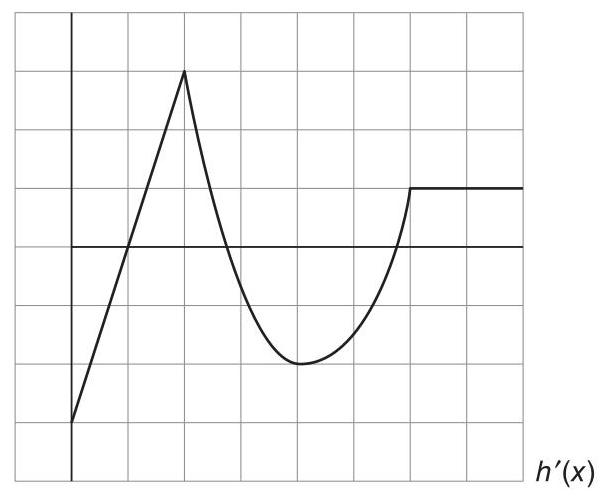
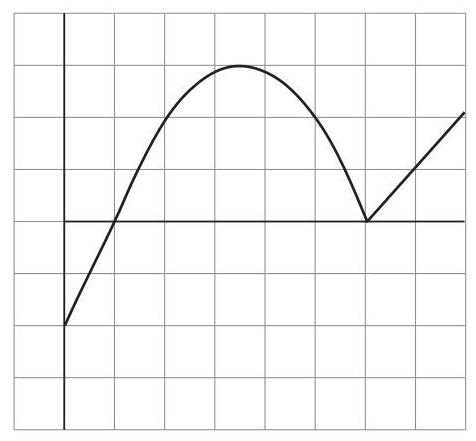
105. The graph of the derivative of \( h(x) \) is given. Which of the following could be the graph of \( h(x) \)?
答案: ( B )
Where \( h' \) goes from negative to positive, \( h \) has a local minimum; where positive to negative, local maximum. \( h' \) constant positive at the end gives constant positive slope in \( h \) .
106. By the Mean Value Theorem there exists \( c \) on \( 1 < x < b \) with \( {f}^{\prime }\left( c\right) = -1/2 \) . Find \( b \) if \( f(x) = 8x - x^3 \) .
答案: ( C )
Slope of secant \( = \frac{f(b)-f(1)}{b-1} = \frac{8b-b^3-7}{b-1} = -1/2 \); solve for \( b > 1 \) gives \( b = 2.28 \) .
107. Which is an inflection point of \( p(x) = x^4 - 2x^3 + 10x - 8 \)?
答案: ( D )
\( p''(x) = 12x^2 - 12x = 0 \) when \( x = 0 \) or \( 1 \); \( p(0) = -8 \), \( p(1) = 1 \). So \( (1,1) \) is an inflection point.
108. What is the rate of change of \( f(x) = \sqrt{9 - x^3} \) at \( x = 2 \)?
答案: ( A )
\( f'(x) = \frac{-3x^2}{2\sqrt{9-x^3}} \); \( f'(2) = \frac{-12}{2\sqrt{1}} = -6 \) .
109. The line tangent to \( g(x) = \ln(x^2 + x + 6) \) at \( x = 0 \) is
答案: ( D )
\( g'(0) = 1/6 \), point \( (0, \ln 6) \); point-slope: \( y - \ln 6 = \frac{1}{6}x \) so \( y = \frac{1}{6}x + \ln 6 \) .

110. The graph of \( g(x) \) is given. Which could be the graph of \( g'(x) \)?
答案: ( D )
At the smooth relative maximum of \( g \), \( g' \) is 0 and decreasing. At the pointed minimum, \( g' \) does not exist and jumps from negative to positive.
111. BC: For which values of \( t \) are \( x = 4 - t \) and \( y = t^2 + t \) (in the xy-plane) increasing?
答案: ( A )
\( dy/dx = (2t+1)/(-1) \); \( dy/dx > 0 \) when \( 2t+1 < 0 \) so \( t < -1/2 \) .
112. If \( y = \ln(8 - x^3) \), then \( \frac{dy}{dx} = \)
答案: ( A )
Chain Rule: \( \frac{dy}{dx} = \frac{1}{8-x^3}(-3x^2) = \frac{3x^2}{x^3-8} \) .
113. BC: Particle follows \( x = \cos(2t), y = \sin(t) \) then at \( t = \pi/4 \) continues along the tangent at \( (0, \sqrt{2}/2) \) . What is the slope of that tangent?
答案: ( C )
\( dx/dt = -2\sin(2t), dy/dt = \cos t \); at \( t = \pi/4 \): \( dy/dx = (\sqrt{2}/2)/(-2) = -\sqrt{2}/4 \) .
| X | f(x) | |
| 0 | 2 | |
| 1 | 5 | |
| 3 | 6 | |
| 6 | 7 | |
| 7 | 5 | |
| 9 | 4 | |
| 10 | 1 |
114. \( f \) is continuous and differentiable on \( 0 \leq x \leq 10 \) . Use the table to determine an interval for which \( f'(c) = 0 \) for some \( c \) (Mean Value Theorem).
答案: ( C )
MVT needs two points with the same secant slope. \( (1,5) \) and \( (7,5) \) have slope 0; interval \( 1 < x < 7 \) .
| ✘ | g(x) |
| -2 | 1.47 |
| -0.94 | 0 |
| 0 | -0.33 |
| 9.08 | 0 |
| 14 | -7.3 |
| 20 | -4.40 |
115. The table gives all critical points of continuous \( g(x) \) . Where is \( g \) increasing on \( -2 < x < 20 \)?
答案: ( A )
\( g \) increases where values go up: from -0.33 to 0 on \( 0 < x < 9.08 \) and from -7.3 to -4.4 on \( 14 < x < 20 \) .
| X | \( h'(x) \) |
| -10 | 33.9 |
| -2.2 | 0 |
| 0 | -9.9 |
| 3.7 | 0 |
| 5 | -2 |
| 9.3 | Does not exist |
| 10 | 8 |
116. The table gives \( h'(x) \) and all critical points of \( h \) . What represents the absolute maximum of \( h(x) \)?
答案: ( D )
\( h' > 0 \) for \( x > 10 \) so \( h \) is increasing there; unknown whether \( h \) is bounded above, so may or may not have an absolute maximum.

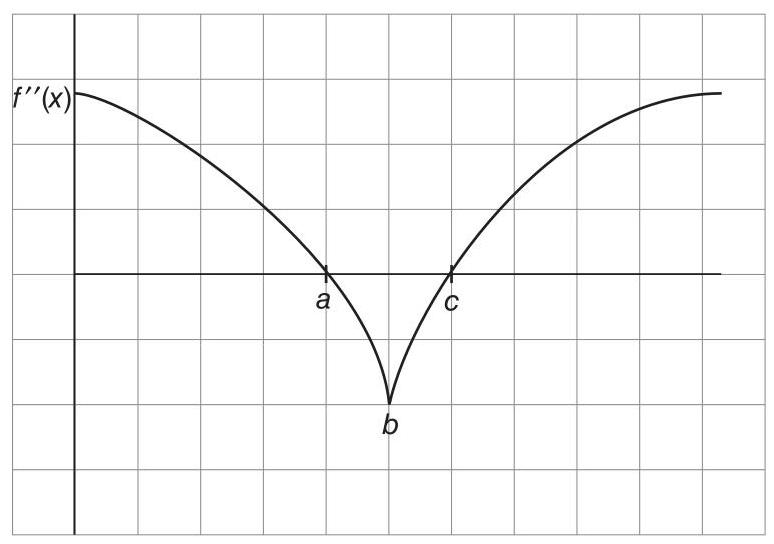
117. The second derivative of \( f \) has zeros at \( x = a \) and \( x = c \) and a minimum at \( x = b \) as shown. \( f \) is concave up
答案: ( D )
\( f \) is concave up where \( f'' > 0 \): when \( 0 < x < a \) and when \( x > c \) .
118. If the tangent to \( y = f(x) \) at \( (-3, 8) \) passes through \( (-2, 5) \), then
答案: ( D )
Slope of tangent = \( \frac{5-8}{-2-(-3)} = -3 \); so \( f'(-3) = -3 \) .

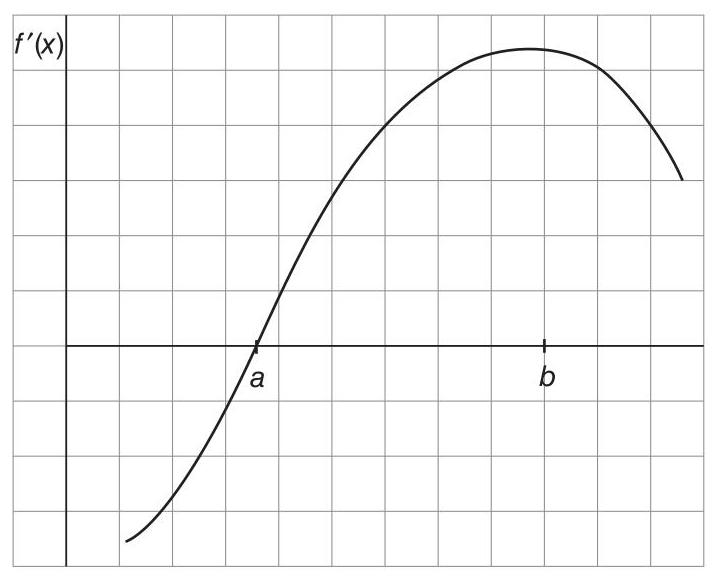
119. The derivative of \( f \) has a zero at \( x = a \) and a relative maximum at \( x = b \) as shown. Which is not true?
答案: ( B )
\( f \) has an inflection point at \( x = b \) (derivative goes from increasing to decreasing), not necessarily an absolute maximum.

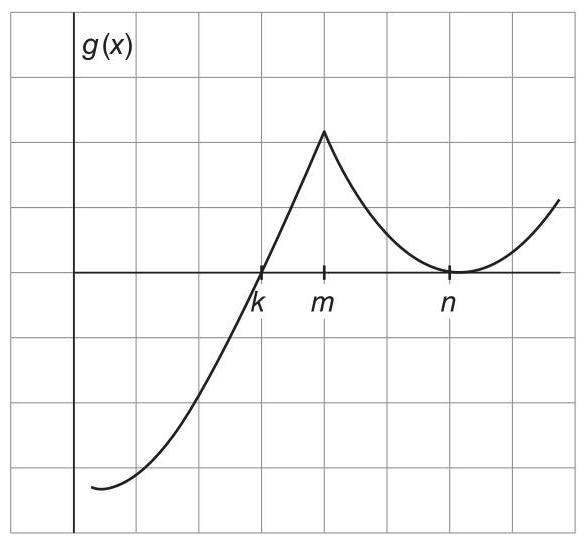
120. The graph of \( g(x) \) has zeros at \( x = k \) and \( x = n \) and a relative maximum at \( m \) as shown. Which is true?
答案: ( D )
\( g \) is concave up everywhere except at \( m \) where \( g' \) does not exist; so \( g'' \) is never negative.
121. BC: For \( f(x) = x^3 - x \) on \( [-1, 1] \), find \( c \) such that the Mean Value Theorem holds.
答案: ( A )
\( f'(c) = 3c^2 - 1 = \frac{f(1)-f(-1)}{2} = 0 \) so \( 3c^2 - 1 = 0 \) ⇒ \( c = \pm \sqrt{1/3} \) .
122. BC: Approximate the angle between vectors \( \mathbf{r}_1 = \langle 2,3\rangle \) and \( \mathbf{r}_2 = \langle 6,4\rangle \) in radians.
答案: ( C )
\( \cos\theta = \frac{\mathbf{r}_1\cdot\mathbf{r}_2}{|\mathbf{r}_1||\mathbf{r}_2|} = \frac{24}{26} = \frac{12}{13} \); \( \theta = \cos^{-1}(12/13) \approx 0.395 \) radians.
123. For \( f(x) = x^3 - 12x \), a local maximum exists at \( x = 2 \) because I. \( f'(2) = 0 \) II. \( f'(1) = -9 \) III. \( f'(3) = 15 \) IV. \( x = 2 \) is not a local maximum for \( f(x) \).
答案: ( D )
\( x = 2 \) is a local minimum (I, II, III show derivative goes negative then positive), so IV is correct.
124. Find all critical point(s) \( c \) for \( f(x) = \frac{2}{3}x^3 + 5x^2 - 28x - 10 \).
答案: ( B )
\( f'(x) = 2x^2 + 10x - 28 = 2(x+7)(x-2) = 0 \) at \( c = -7, 2 \) .
125. Find an inflection point for \( f(x) = 2x(x+4)^3 \).
答案: ( B )
\( f''(x) = 12x(x+4) + 12(x+4)^2 \); \( f'' = 0 \) when \( x = -4 \); \( f(-4) = 0 \) so \( (-4,0) \) is an inflection point.
126. BC: Find the polar equation of the ellipse \( \frac{x^2}{25} + \frac{y^2}{16} = 1 \).
答案: ( C )
\( 16r^2\cos^2\theta + 25r^2\sin^2\theta = 400 \); \( r^2 = \frac{400}{16\cos^2\theta + 25\sin^2\theta} \); using \( \cos^2\theta = 1 - \sin^2\theta \) gives \( r = \frac{20}{\sqrt{16+9\sin^2\theta}} \) .
127. Let \( f(x) = \sin x \) on \( [0, \pi/2] \). Find an approximation to the number(s) \( c \) that satisfy the Mean Value Theorem.
答案: ( D )
\( f'(c) = \cos c = \frac{f(\pi/2)-f(0)}{\pi/2} = \frac{2}{\pi} \); \( c = \cos^{-1}(2/\pi) \approx 0.8807 \) .
128. Which of the following is true for \( f(x) = x^{2/3} \)? I. There is a critical point at \( (0,0) \). II. \( f'(0) \) and \( f''(0) \) are undefined. III. The curve is concave up over \( (0, +\infty) \). IV. The curve is concave down over \( (-\infty, 0) \).
答案: ( C )
\( f'(x) = \frac{2}{3}x^{-1/3} \) so \( f'(0) \) undefined; critical point at (0,0). \( f''(x) = -\frac{2}{9}x^{-4/3} < 0 \) for \( x \neq 0 \), so concave down on both \( (-\infty,0) \) and \( (0,+\infty) \); III is false.
129. If \( f'(x) = 2x^2 - 5 \), find the interval(s) where \( f \) is decreasing.
答案: ( D )
\( f'(x) = 0 \) when \( x = \pm \sqrt{5/2} \); \( f'(x) < 0 \) on \( (-\sqrt{5/2}, \sqrt{5/2}) \) so \( f \) is decreasing there.
130. BC: Find the components of the vector of magnitude 6 and direction \( \frac{\pi}{6} \).
答案: ( A )
\( x = 6\cos(\pi/6) = 3\sqrt{3} \), \( y = 6\sin(\pi/6) = 3 \); vector is \( \langle 3\sqrt{3}, 3 \rangle \) .
131. For \( f(x) = \frac{1}{x-1} \), determine the concavity on \( (-\infty, 1) \) and \( (1, +\infty) \) respectively.
答案: ( B )
\( f''(x) = \frac{2}{(x-1)^3} \); \( f'' < 0 \) for \( x < 1 \) (concave down), \( f'' > 0 \) for \( x > 1 \) (concave up).
132. BC: Determine the symmetry of the graph of \( r = 6\cos(3\theta) \).
答案: ( D )
\( 6\cos(3(-\theta)) = 6\cos(3\theta) \) so symmetric about x-axis; checks for y-axis and pole show no symmetry.
133. Determine the intervals on which \( f(x) = x^3 - x^2 \) increases and decreases.
答案: ( C )
\( f'(x) = 3x^2 - 2x = x(3x-2) = 0 \) at \( x = 0, 2/3 \); \( f' > 0 \) for \( x < 0 \) and \( x > 2/3 \); \( f' < 0 \) on \( (0, 2/3) \) .
134. If \( f(x) = |x^2 - 4| \), which statements about \( f \) are true? I. \( f \) is continuous on \( (-\infty, +\infty) \). II. \( f \) has points of inflection at \( x = \pm 2 \). III. \( f \) has a relative maximum at \( (0, 4) \).
答案: ( D )
\( f \) is continuous (I). \( f' \) has discontinuities at \( x = \pm 2 \) so no inflection there (II false). \( f'(0) = 0 \) and \( f''(0) < 0 \) so relative max at \( (0,4) \) (III).
135. BC: Find the length and direction of the vector \( \langle 3, 3\sqrt{3} \rangle \).
答案: ( C )
\( \|\mathbf{r}\| = \sqrt{9 + 27} = 6 \); \( \theta = \tan^{-1}(3\sqrt{3}/3) = \tan^{-1}(\sqrt{3}) = \pi/3 \) .
136. Find the critical point(s) of \( f(x) = 4x^2 - 3x + 2 \).
答案: ( D )
\( f'(x) = 8x - 3 = 0 \) when \( x = 3/8 \) .
137. Determine \( a \) and \( b \) in \( f(x) = ax^3 + b/x \) such that \( (1, 4) \) is a relative maximum and \( (-1, -4) \) is a relative minimum.
答案: ( C )
\( f(1) = a + b = 4 \), \( f(-1) = -a - b = -4 \); \( f'(x) = 3ax^2 - b/x^2 = 0 \) at \( x = \pm 1 \) gives \( 3a = b \); so \( a = 1, b = 3 \) .
138. BC: Find the equation for \( r^2\cos(2\theta) = 1 \) in Cartesian coordinates.
答案: ( D )
\( r^2\cos(2\theta) = r^2(\cos^2\theta - \sin^2\theta) = x^2 - y^2 \); so \( x^2 - y^2 = 1 \) .
139. Verify whether \( f(x) = 3x^2 - 12x + 1 \) satisfies the Mean Value Theorem on \( [0, 4] \) and find all \( c \) such that \( f'(c) = 0 \) (slope of secant).
答案: ( C )
\( f \) is continuous and differentiable on \( [0,4] \); \( f(0) = 1 \), \( f(4) = 1 \); secant slope 0; \( f'(c) = 6c - 12 = 0 \) when \( c = 2 \) .
140. Find the interval(s) where \( f(x) \) is increasing if \( f'(x) = x^4 - 16 \).
答案: ( C )
\( f'(x) = 0 \) when \( x^4 = 16 \) so \( x = \pm 2 \); \( f'(x) > 0 \) on \( (-\infty, -2) \) and \( (2, +\infty) \) .
141. BC: A parametric curve is given by \( x = \ln t \) and \( y = 4t + 1 \). Find the Cartesian equation of the curve.
答案: ( D )
\( t = e^x \) so \( y = 4e^x + 1 \) .
142. Find the relative maximum and minimum values for \( f(x) = 2x^3 + x^2 + 15 \) on \( [-4, 4] \).
答案: ( D )
\( f'(x) = 6x^2 + 2x = 0 \) at \( x = -1/3, 0 \); \( f''(-1/3) < 0 \) (max), \( f''(0) > 0 \) (min); \( f(0) = 15 \), \( f(-1/3) = 406/27 \) .
143. \( f'(x) = 3x^2 - 2x + 1 \). Find the concavity of \( f \) on \( (-\infty, 1/3) \) and \( (1/3, +\infty) \) respectively.
答案: ( A )
\( f''(x) = 6x - 2 = 0 \) when \( x = 1/3 \); \( f'' < 0 \) for \( x < 1/3 \), \( f'' > 0 \) for \( x > 1/3 \) .
144. BC: What shape is described by \( r = 5\cos(4\theta) \)?
答案: ( B )
\( r = a\cos(n\theta) \) with \( n \) even gives a rose with \( 2n \) petals; \( n = 4 \) ⇒ 8 petals of length 5.

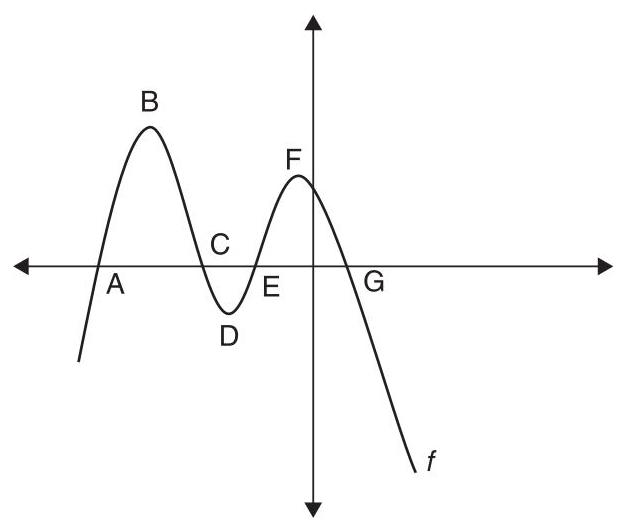
145. Which of the following are true of the graph of \( f \) below? I. \( f' \geq 0 \) on the interval from D to F II. \( f'' = 0 \) at points B, D, and F III. \( f'' > 0 \) on the interval from A to B IV. \( f'' > 0 \) on the interval from D to F
答案: ( A )
I: \( f \) is increasing D to F. II: horizontal tangents at B, D, F so \( f' = 0 \) there (and \( f'' \) can be 0). III: concave down A to B. IV: concave down E to F.
146A. 146. (A) \( f(x) = 1 - \sqrt[3]{x} \) — Find the intervals on which \( f \) is increasing or decreasing.
\( f'(x) = -\frac{1}{3}x^{-2/3} < 0 \) for all \( x \neq 0 \), so \( f \) is decreasing on \( (-\infty, +\infty) \) .
146B. 146. (B) Locate all maxima and minima.
\( f' < 0 \) for all \( x \); at \( x = 0 \), \( f' \) does not exist. There are no maxima or minima.
146C. 146. (C) Find the intervals over which \( f \) is concave upward or downward.
\( f''(x) = \frac{2}{9}x^{-5/3} \); \( f'' > 0 \) when \( x > 0 \) (concave up on \( (0, +\infty) \)); \( f'' < 0 \) when \( x < 0 \) (concave down on \( (-\infty, 0) \)).
146D. 146. (D) Find all inflection points.
\( f'' \) changes sign at \( x = 0 \); \( f(0) = 1 \), so inflection point at \( (0, 1) \) (also the y-intercept).
146E. 146. (E) Sketch the graph of \( f \).
y-intercept at \( (0, 1) \), x-intercept at \( (1, 0) \); decreasing, concave down for \( x < 0 \) and concave up for \( x > 0 \) with inflection at (0,1).
147A. BC 147. (A) Vectors \( \langle 1, -4 \rangle \) and \( \langle 2, k \rangle \) — Find \( k \) such that the vectors are orthogonal.
Dot product \( 1(2) + (-4)k = 0 \) ⇒ \( 2 - 4k = 0 \) ⇒ \( k = 1/2 \) .
147B. 147. (B) Find \( k \) such that the vectors are parallel.
Parallel ⇒ one is a scalar multiple of the other; horizontal component ratio 2:1 gives \( k = -8 \) (or \( \cos\theta = -1 \) gives \( k = -8 \)).
147C. 147. (C) If \( k = 6 \), find the angle between the two vectors. Round to the nearest tenth of a degree.
\( \mathbf{r}_1 \cdot \mathbf{r}_2 = 2 - 24 = -22 \); \( |\mathbf{r}_1| = \sqrt{17} \), \( |\mathbf{r}_2| = 2\sqrt{10} \); \( \theta = \cos^{-1}(-22/(2\sqrt{170})) \approx 147.5° \) .
148A. 148. (A) A force of 2 N to the right, 4 N from below, 8 N to the left at \( \pi/3 \) above horizontal. Find the resultant force vector.
\( \mathbf{f}_1 = \langle -2, 0 \rangle \), \( \mathbf{f}_2 = \langle 0, 4 \rangle \), \( \mathbf{f}_3 = \langle 8\cos(\pi/3), -8\sin(\pi/3) \rangle = \langle 4, -4\sqrt{3} \rangle \); total \( = \langle 2, 4 - 4\sqrt{3} \rangle \) N.
148B. 148. (B) Find the magnitude of the total force (to the nearest hundredth).
\( \|\mathbf{f}\| = \sqrt{4 + (4-4\sqrt{3})^2} = \sqrt{68 - 32\sqrt{3}} \approx 11.11 \) newtons.
148C. 148. (C) What additional force vector would keep the object from moving?
Apply equal and opposite force: \( \mathbf{f}_{opp} = \langle -2, -4 + 4\sqrt{3} \rangle \) N.

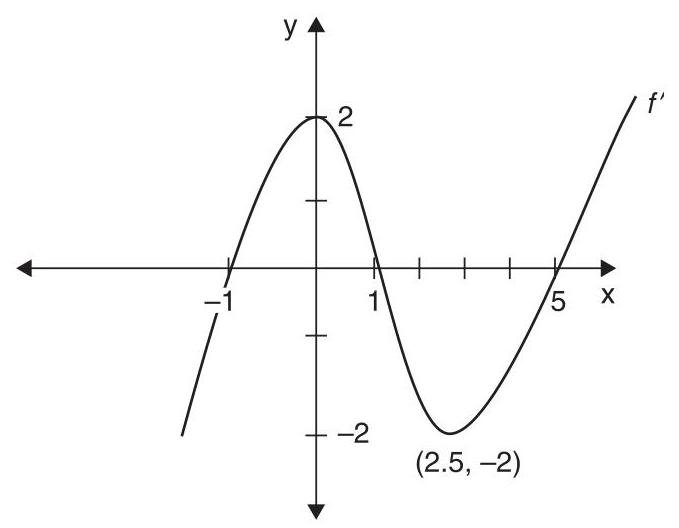
149A. 149. Given the graph of \( f' \): (A) The intervals on which \( f \) is increasing or decreasing.
\( f' < 0 \) on \( (-\infty, -1) \) and \( (1, 5) \) so \( f \) is decreasing; \( f' > 0 \) on \( (-1, 1) \) and \( (5, +\infty) \) so \( f \) is increasing.

149B. 149. (B) The location of the relative maxima and minima.
Relative maximum at \( x = 1 \) (\( f' \) changes from positive to negative); relative minima at \( x = -1 \) and \( x = 5 \) (\( f' \) changes from negative to positive).

149C. 149. (C) The points of inflection and concavity of \( f \).
\( f' \) increasing on \( (-\infty, 0) \) ⇒ \( f'' > 0 \) (concave up); \( f' \) decreasing on \( (0, 2.5) \) ⇒ \( f'' < 0 \) (concave down); \( f' \) increasing on \( (2.5, +\infty) \) ⇒ \( f'' > 0 \) (concave up). Inflection at \( x = 0 \) and \( x = 2.5 \) .

149D. 149. (D) Draw a sketch of \( f \), given \( f(-1) = f(1) = 5 \), \( f(0) = 0 \), \( f(5) = -5 \).
Use increasing/decreasing and concavity from (A)–(C) and the given points to sketch: local max at 1, local mins at -1 and 5, inflection at 0 and 2.5.
150A. 150. \( f(x) = x^4 - x^3 \) — (A) Find the intervals on which \( f \) is increasing or decreasing.
\( f'(x) = 4x^3 - 3x^2 = x^2(4x-3) = 0 \) at \( x = 0, 3/4 \); \( f' > 0 \) for \( x > 3/4 \) (increasing); \( f' < 0 \) for \( x < 0 \) and \( 0 < x < 3/4 \) (decreasing).
150B. 150. (B) Locate all maxima and minima.
\( f'(0) = f'(3/4) = 0 \); \( f''(0) = 0 \) (inconclusive); first derivative changes sign: relative maximum at \( x = 0 \) (\( f(0) = 0 \)). \( f''(3/4) > 0 \) ⇒ relative minimum at \( x = 3/4 \), \( f(3/4) = -27/256 \) .
150C. 150. (C) Find the points of inflection, if any.
\( f''(x) = 12x^2 - 6x = 6x(2x-1) = 0 \) at \( x = 0, 1/2 \); inflection points at \( (0, 0) \) and \( (1/2, -1/16) \) .
150D. 150. (D) Find the intervals where \( f \) is concave upward or downward.
\( f'' > 0 \) on \( (-\infty, 0) \) and \( (1/2, +\infty) \) (concave up); \( f'' < 0 \) on \( (0, 1/2) \) (concave down).
150E. 150. (E) Sketch the graph of \( f(x) = x^4 - x^3 \).
Use (A)–(D): relative max at (0,0), relative min at (3/4, -27/256), inflection at (0,0) and (1/2, -1/16); concavity and monotonicity as above.