351. If you were to use 3 midpoint rectangles of equal length to approximate the area under the curve of \( f(x)=x^2+2 \) from \( x=0 \) to \( x=3 \), how close would the approximation be to the exact area?
答案: ( B )
Exact area = 15; midpoint sum = 14.75; difference = 1/4.
352. Find the exact area of the region bounded by \( f(x)=\sin x \), \( g(x)=\cos x \), and the lines \( x=0 \) to \( x=\pi/2 \).
答案: ( D )
\( \int_0^{\pi/2}|\sin x-\cos x|\,dx = 2\sqrt{2}-2 \) .
353. Find the exact area under the curve \( f(x)=\tan x \) from \( x=0 \) to \( x=\pi/3 \).
答案: ( D )
\( u=\cos x \) gives \( \ln|u|\big|_{1/2}^1 = \ln 2 \) .
354. Solve for \( b>1 \) when the area underneath \( y=\frac{\ln x}{x} \) from \( x=1 \) to \( x=b \) is exactly 2.
答案: ( A )
\( 2=\frac{(\ln b)^2}{2} \) so \( \ln b=2 \) and \( b=e^2 \) .

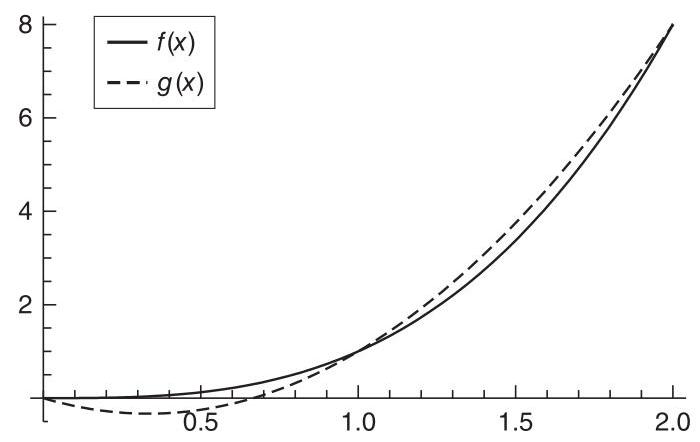
355. Find the area of the region bounded by \( f(x)=x^3 \) and \( g(x)=3x^2-2x \) shown below.
答案: ( C )
\( \int_0^2|f-g|\,dx \) split at x=1 gives 1/4+1/4=1/2.
356. Find the area bounded by \( y=e^{-x}+2 \) and the lines \( y=-x/2 \), \( x=0 \), and \( x=1 \).
答案: ( D )
\( \int_0^1(e^{-x}+2+x/2)\,dx = \frac{13e-4}{4e} \) .
357. For \( \int_1^5(f(x)-g(x))\,dx \) to yield the area between the curves on [1,5], which must hold? I. f and g continuous. II. \( f(x)\geq g(x) \). III. \( g(x)\geq f(x) \).
答案: ( C )
Both continuous and \( f\geq g \) so integrand is positive vertical distance.
358. BC: Find the area under \( f(x)=2x\ln x \) on \( [1,e] \).
答案: ( B )
By parts: \( [x^2\ln x]_1^e - \int_1^e x\,dx = \frac{1}{2}(e^2+1) \) .
359. Find the area under \( y=\cos^2 x \) from \( x=-\pi/6 \) to \( x=\pi/6 \).
答案: ( D )
\( 2\int_0^{\pi/6}\cos^2 x\,dx = \frac{\pi}{6}+\frac{\sqrt{3}}{4} \) .
360. Find the area of the region bounded by \( f(x)=2e^{x/2} \), \( y=3 \), and \( x=4 \).
答案: ( D )
Area \( \int_{2\ln(3/2)}^4(2e^{x/2}-3)\,dx = 4e^2+6\ln(3/2)-18 \) .
361. Find the area under the curve of \( f(x)=\frac{\sec x+\csc x}{1+\tan x} \) from \( x=\pi/6 \) to \( x=\pi/3 \).
答案: ( C )
Simplifies to \( \csc x \); \( \int_{\pi/6}^{\pi/3}\csc x\,dx = \ln|\csc x-\cot x|\big|_{\pi/6}^{\pi/3} \approx 0.768 \) .
362. Find the area of the region bounded by the curves \( f(x)=\ln x \) and \( g(x)=3-2\ln x \) and the line \( x=e^2 \).
答案: ( A )
Intersection \( \ln x=1 \) at \( x=e \); \( f\geq g \) on \( [e,e^2] \); \( 3\int_e^{e^2}(\ln x-1)\,dx = 3e \) .
363. Find the area of the region properly contained with \( 0\leq x\leq\pi \) and bounded by the curves \( y=\cos x \) and \( y=\cos(2x) \).
答案: ( A )
Intersection in \( (0,\pi) \) at \( \theta=2\pi/3 \); \( \int_0^{2\pi/3}(\cos x-\cos(2x))\,dx = \frac{3\sqrt{3}}{4} \) .
364. Let \( f(x)=x^2+1 \). Let A = area under \( y=f(x) \) from 0 to \( a>0 \), B = area from 0 to \( 2a \), and \( 3A=B \). Solve for \( a \).
答案: ( B )
\( 3A = a^3+3a \), \( B = \frac{8a^3}{3}+2a \); \( 3A=B \) gives \( 5a^2=3 \) so \( a=\sqrt{3/5} \) .
365. Let \( f(x)=1/x \). Let A = area under \( y=f(x) \) from 1 to \( a>0 \), B from 1 to \( b>0 \), and \( 2A=B \). Write \( b \) in terms of \( a \).
答案: ( B )
\( 2\ln a = \ln b \) so \( b=a^2 \) .
366. Find the volume of the solid generated by rotating the area in the first quadrant between \( y=2x+3 \) and \( y=x^2 \) around the axis \( x=4 \).
答案: ( D )
Washers in \( y \); outer radius \( 4-\frac{y-3}{2} \) for \( y\in[3,9] \) and inner \( 4-\sqrt{y} \); option D gives correct washer formula.
367. If \( g'(x)=f(x) \), which represents the area under \( h(x)=xf(x^2) \) from \( x=0 \) to \( x=3 \)?
答案: ( D )
Substitute \( u=x^2 \); \( \int_0^3 xf(x^2)\,dx = \frac{1}{2}\int_0^9 f(u)\,du = \frac{1}{2}(g(9)-g(0)) \) .
368. (Use a calculator.) Find the area (to three decimal places) of the region bounded by \( f(x)=e^x-1 \), \( g(x)=\cos x \), and the \( y \)-axis.
答案: ( D )
\( \int_0^r (\cos x-(e^x-1))\,dx \) where \( r\approx 0.601 \) is the intersection; \( \approx 0.343 \) .
369. BC: Find the area underneath the curve defined by \( x=t+e^t \), \( y=1+e^t \) when \( 0\leq t\leq\ln 2 \).
答案: ( C )
\( \int_1^{2+\ln 2} y\,dx = \int_0^{\ln 2}(1+e^t)^2\,dt = \ln 2 - \frac{7}{2} \) .
370. BC: Find the area of the region in the second quadrant bounded by the \( y \)-axis and the curve \( x=t^2+4t \), \( y=2-t \).
答案: ( D )
\( -\int_2^6 x\,dy = -\int_0^{-4}(t^2+4t)(-1)\,dt = [\frac{t^3}{3}+2t^2]_0^{-4} = \frac{32}{3} \) .
371. BC: Find the area inside \( r=\cos(2\theta) \) and outside \( r=1/2 \) when \( -\pi/4\leq\theta\leq\pi/4 \).
答案: ( D )
Half integral of r^2 difference gives D.
372. BC: Find the area in first and fourth quadrants bounded by \( r=3+2\sin\theta \).
答案: ( B )
\( \frac{1}{2}\int_{-\pi/2}^{\pi/2}(3+2\sin\theta)^2\,d\theta = \frac{11\pi}{2} \) .
373. Solid: base enclosed by \( x=y^2 \) and \( x=3 \), square cross sections perp. to x-axis. Find volume.
答案: ( C )
Area 4x; \( \int_0^3 4x\,dx = 18 \) .
374. Base: first quadrant enclosed by \( xy=3 \) and \( y=4-x \); rectangular cross sections height twice base. Volume?
答案: ( A )
\( \int_1^3 2(4-x-3/x)^2\,dx \approx 0.6 \) .
375. Base: \( y=\log_2 x \), \( y=-1 \), \( x=2 \); cross sections perp. to y-axis are regular triangles. Volume?
答案: ( C )
\( \int_{-1}^1 \frac{\sqrt{3}}{4}(2-2^y)^2\,dy \approx 0.887 \) .
376. BC: Volume from revolving about x-axis region bounded by \( y=\ln x \) and \( x=e \).
答案: ( D )
\( \pi\int_1^e (\ln x)^2\,dx = \pi(e-2) \) .
377. D = unit circle. Volume of solid from revolving D about line \( x=2 \).
答案: ( A )
Washers; \( V=\frac{8\pi}{3}+4\pi^2 \) .
378. Volume from revolving about \( y=1 \) region bounded by \( y=\pm\tan x \), y-axis, \( x=\pi/4 \).
答案: ( B )
\( V=2\pi(1-\pi/4+\ln 2) \) .
379. \( f(x)=\sec x \) for \( |x|<\pi/2 \). Volume of solid from rotating region above \( y=f(x) \) below \( y=2 \) about x-axis.
答案: ( C )
\( 2\pi\int_0^{\pi/3}(4-\sec^2 x)\,dx = 2\pi(4\pi/3-\sqrt{3}) \) .
380. Volume from rotating about \( y=-1 \) the region in QI bounded by \( y=3-x \) and \( y=2/x \).
答案: ( D )
Washers \( \pi\int_1^2((4-x)^2-(1+2/x)^2)\,dx = \pi(10/3-4\ln 2) \) .
381. A solid S has base a triangular region with vertices (0,0), (3,0), and (0,1), and parallel cross sections perpendicular to the \( x \)-axis are squares. What is the volume of S?
答案: ( D )
Square side from triangle hypotenuse; volume integral gives (D) 5.
382. Let \( a>0 \). The solid S is obtained by revolving about the \( y \)-axis the region bounded by \( y=x \), the \( x \)-axis, and \( x=a \). If the volume is \( 18\pi \), find \( a \).
答案: ( D )
\( \pi\int_0^a(a^2-y^2)\,dy = \frac{2\pi a^3}{3}=18\pi \) so \( a=3 \) .
383. Find the volume of the solid obtained by rotating the region bounded by the right triangle with vertices at the origin, (6,0), and (6,3) about the \( x \)-axis.
答案: ( B )
Cone: radius 3, height 6; \( V=\frac{1}{3}\pi\cdot 9\cdot 6 = 18\pi \) .
384. BC: Find the area of the surface generated by revolving about the \( x \)-axis the curve \( x=2\sin^2 t \), \( y=\sin(2t) \) when \( 0\leq t\leq\pi/2 \).
答案: ( C )
\( 2\pi\int y\sqrt{(dx/dt)^2+(dy/dt)^2}\,dt = 4\pi\int_0^{\pi/2}\sin(2t)\,dt = 4\pi \) .
385. BC: Find the surface area obtained by rotating about the \( x \)-axis the curve \( x=t^2+1 \), \( y=t \) when \( 0\leq t\leq 1 \).
答案: ( D )
\( 2\pi\int_0^1 t\sqrt{4t^2+1}\,dt \); \( u=4t^2+1 \) gives \( \frac{\pi}{6}(5\sqrt{5}-1) \) .
386. BC: Find the surface area generated by rotating about the \( x \)-axis the curve \( x=4e^{t/2} \), \( y=e^t-4t \) when \( 0\leq t\leq 1 \).
答案: ( D )
\( 2\pi\int_0^1(y\sqrt{(dx/dt)^2+(dy/dt)^2})\,dt = \pi(e^2-4e+3) \) .
387. BC: Find the length of the polar curve \( r=e^\theta \) when \( 0\leq\theta\leq 2\pi \).
答案: ( C )
\( \int_0^{2\pi}\sqrt{r^2+(dr/d\theta)^2}\,d\theta = \sqrt{2}\int_0^{2\pi}e^\theta\,d\theta = \sqrt{2}(e^{2\pi}-1) \) .
388. BC: Find the length of the polar curve \( r=\sin\theta-\cos\theta \) when \( 0\leq\theta\leq\pi \).
答案: ( B )
\( r^2+(dr/d\theta)^2=2 \); length \( \int_0^\pi\sqrt{2}\,d\theta = \sqrt{2}\pi \) .
389. BC: The curve \( x=\cos t+t\sin t \), \( y=\sin t-t\cos t \) for \( 0\leq t\leq a \) has length \( 2\pi^2 \). Find \( a \).
答案: ( C )
\( \sqrt{(dx/dt)^2+(dy/dt)^2}=t \); \( \int_0^a t\,dt = a^2/2 = 2\pi^2 \) so \( a=2\pi \) .
390. Let \( f(t)=t^4+2t^2-3 \) and \( F(x)=\int_{-3}^x f(t)\,dt \). At what \( x \)-value(s) does \( F(x) \) have a local minimum?
答案: ( A )
\( F'(x)=f(x)=0 \) gives \( (x^2-1)(x^2+3)=0 \) so \( x=\pm 1 \); \( F''(1)>0 \) so only \( x=1 \) is local min.
391. Find the approximate area under \( y=e^x \) from \( x=0 \) to \( x=\ln 8 \) using 3 trapezoids.
答案: ( C )
\( \frac{\ln 8}{6}(e^0+2e^{\ln 2}+2e^{2\ln 2}+e^{3\ln 2}) = \frac{21\ln 2}{2} \) .
392. BC: Acceleration \( a(t)=\langle \pi^2\sin(\pi t), 6t \rangle \). Particle at origin at t=0 and at i+j at t=2. Find position \( s(t) \).
答案: ( A )
Integrate a for v, then v for s; use s(0)=0 and s(2)=i+j to get C; s(t)=(t/2-sin(pi t))i+(t^3-7t/2)j.
393. BC: Find the length of \( r(t)=\langle \ln|\sec t|, t \rangle \) from \( t=0 \) to \( t=\pi/4 \).
答案: ( C )
\( |r'(t)|=\sec t \); \( \int_0^{\pi/4}\sec t\,dt = \ln(\sqrt{2}+1) \) .
394. BC: \( r(t)=\langle e^t,\sqrt{3}e^t \rangle \) from t=0 to t=k has length 8. Solve for k.
答案: ( D )
\( |r'(t)|=2e^t \); \( 2(e^k-1)=8 \) so \( e^k=5 \), \( k=\ln 5 \) .
395. \( g(x)=\int_0^x(\log_2(t-1)+\log_2(t+1))\,dt \). Find all x where the tangent to \( y=g(x) \) is horizontal.
答案: ( A )
\( g'(x)=0 \) gives \( \log_2((x-1)(x+1))=0 \) so \( x^2-1=1 \), \( x=\pm\sqrt{2} \); domain gives \( x=\sqrt{2} \) .

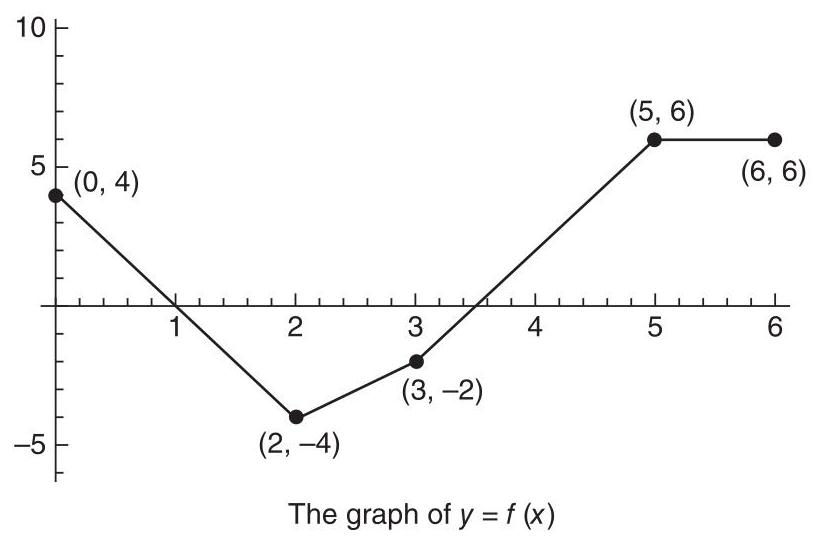
396A. 396. Let \( g(t)=\int_0^t f(x)\,dx \) with graph of f shown. (A) Evaluate \( g(0), g(2), g(6) \).
g(0)=0; g(2)= area 0 to 2 = 0; g(6)= 0+(-3)+4+6 = 7.

396B. 396. (B) On what interval(s) is g increasing? Justify.
g increasing where g'(t)=f(t)>0: [0,1) and (7/2,6].

396C. 396. (C) At what value(s) of t does g have a minimum? Justify.
At t=7/2; g(0)=0, g(7/2)=-7/2, g(6)=7 so minimum at 7/2.

396D. 396. (D) On what interval(s) is g concave down? Justify.
g''=f' < 0 only on (0,2), so g concave down on (0,2).

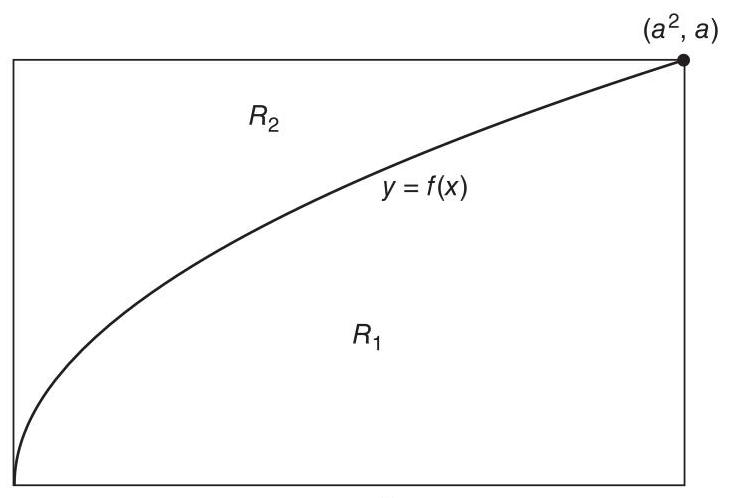
397A. 397. Regions R1 and R2 in figure: rectangle [0,a^2] x [0,a] cut by \( y=\sqrt{x} \). (A) Is there a>0 such that R1 and R2 have equal area? Justify.
A1=2a^3/3, A2=a^3/3; A1=A2 gives a^3=0 so no a>0.

397B. 397. (B) If line x=b divides R1 into two equal areas, express b in terms of a.
\( \frac{2}{3}b^{3/2}=\frac{1}{2}A_1 \); \( 2b^{3/2}=a^3 \) so \( b=a^2/\sqrt[3]{4} \) .

397C. 397. (C) Volume of solid from revolving R1 about the y-axis, in terms of a.
\( \pi\int_0^a(a^4-y^4)\,dy = \frac{4\pi a^5}{5} \) .

397D. 397. (D) R2 as base, cross sections perp. to y-axis are squares. Volume in terms of a.
\( \int_0^a y^4\,dy = \frac{1}{5}a^5 \) .

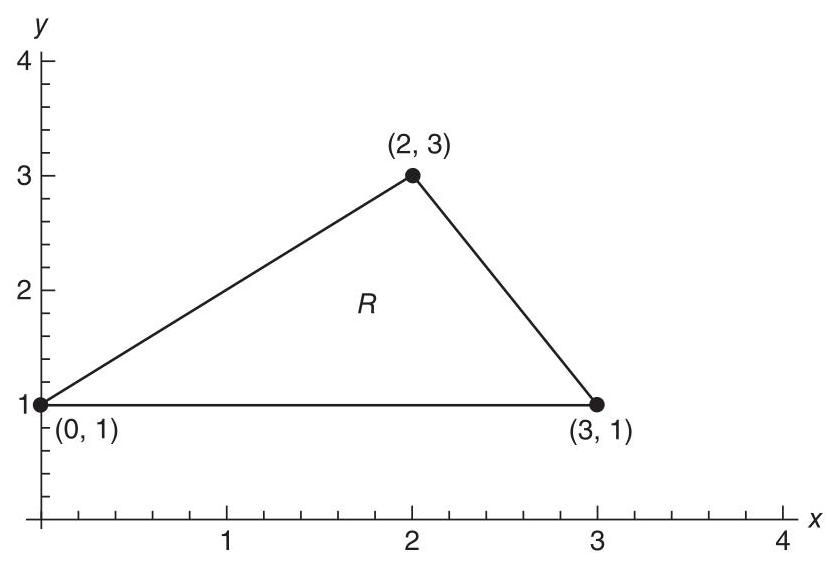
398A. 398. Triangle R with vertices A(0,1), B(2,3), C(3,1). (A) Volume of solid from rotating R about the x-axis.
Washers; \( \pi\int_0^2((x+1)^2-1)\,dx + \pi\int_2^3((7-2x)^2-1)\,dx = 10\pi \) .

398B. 398. (B) Volume of solid from rotating R about the y-axis.
\( \pi\int_1^3((7-y)^2/4-(y-1)^2)\,dy = 10\pi \) .

398C. 398. (C) Volume of solid with base R and square cross sections perp. to x-axis.
\( \int_0^2 x^2\,dx + 4\int_2^3(x^2-6x+9)\,dx = 4 \) .
399A. 399. Region R under \( y=\cos x \) from x=0 to x=pi/2. (A) Find the area of R.
\( \int_0^{\pi/2}\cos x\,dx = 1 \) .
399B. 399. (B) Volume of solid from rotating R about the x-axis.
\( \pi\int_0^{\pi/2}\cos^2 x\,dx = \frac{\pi^2}{4} \) .
399C. 399. (C) R is slab surface; depth d(x)=sin x+1 (feet). Find volume in cubic feet.
\( \int_0^{\pi/2}(\sin x+1)\cos x\,dx = \frac{3}{2} \) ft^3.
400A. BC 400. Curve \( x=\sin t-\cos t \), \( y=\sin t+\cos t \). (A) Length from \( \pi/4\leq t\leq\pi/2 \).
\( \sqrt{(dx/dt)^2+(dy/dt)^2}=\sqrt{2} \); length \( \sqrt{2}(\pi/2-\pi/4)=\frac{\sqrt{2}\pi}{4} \) .
400B. 400. (B) Area bounded underneath the curve from \( \pi/4\leq t\leq\pi/2 \).
\( \int_{\pi/4}^{\pi/2}(\sin t+\cos t)^2\,dt = \frac{\pi}{4}+\frac{1}{2} \) .
400C. 400. (C) Surface area from revolving the curve (pi/4 to pi/2) about the x-axis.
\( 2\pi\int_{\pi/4}^{\pi/2}(\sin t+\cos t)\sqrt{2}\,dt = 2\sqrt{2}\pi(1-0)=2\sqrt{2}\pi \) .